


Port of Lobito
Lobito | BenguelaLocation and geostrategic position:
- South Atlantic, at latitude 12° 20' South and longitude 13° 34', on the southern coast of Benguela province, in a natural deep-water bay, 500 km south of the city of Luanda.
- Being one of the largest natural ports on the west coast of Africa, it offers a large protected anchorage area in Lobito Bay and a wide, deep entrance channel from the Atlantic Ocean.
- It is the access point for connection to the "Lobito Corridor", making it possible to link the Atlantic coast of Angola to several inland cities through the Benguela Railway (CFB).

Operation Model:
- The concession for the multipurpose and container terminals was awarded to AGL Lobito Terminal (ALT), belonging to the Africa Global Logistics group, a global logistics operator integrated into the MSC group, the global leader in maritime transport and port management.
- The initial investment (CAPEX) already made by ALT amounts to USD 80 million (out of a planned total of USD 200 million), aimed at modernising infrastructure, acquiring port equipment and digitalising operations, reinforcing efficiency and competitiveness, to position the Port of Lobito as a strategic hub for the regional logistics corridor linking Angola, Zambia and DRC.

- The Mineral Terminal, concessioned to LAR, has modern infrastructure capable of receiving vessels up to 50,000 DWT, with a draught of 15.3 m and 310 m of quay.
- It is prepared to handle mineral cargo and other bulk goods, both for import and export, reinforcing the strategic role of the Port of Lobito as a regional logistics hub.


Catumbela Industrial Development Pole
Catumbela | Benguela- The PDIC was created by decree of the Council of Ministers of Angola in 1999 as part of the national industrialisation plan, and is located on National Road 100, next to the 4 de Abril Bridge, in the municipality of Catumbela, Benguela province.
- It offers turn-key plots and infrastructure for industrial installation (electricity network, drinking water, drainage, roads) and aims to attract industries in the food and beverages, cement and concrete, packaging, metallurgy and consumer goods sectors.
- It already hosts more than 100 business units, generating around 3,800 direct jobs, although the effective installation rate is still considered low, with the aim of significantly increasing the industrial occupancy rate.
- Connection to the Port of Lobito, Catumbela Airport, EN-100 and Benguela Railway.

PDIC Development:
- PHASE 1 - Located in the perimeter of the Catumbela municipality town, along EN 100. It has an area of approximately 201.55 hectares.
- PHASE 2 - Located in the vicinity of Luongo - Gama alongside the EN 100 road. It has an area of more than 775.61 hectares.
- PHASE 3 - Expansion Area - Located in the commune of Biópio, 15km from the City of Lobito, next to the Catumbela River and close to the energy network distribution centre (Lumaum and Biópio). It has an area of 1,000 hectares.


Catumbela International Airport
Catumbela | Benguela- Catumbela International Airport, inaugurated in 2012, is one of the most modern airport infrastructures in Angola, located between the cities of Lobito and Benguela, with the capacity to receive domestic and international flights.
- It has a 3,700-metre runway, capable of receiving large aircraft such as the Boeing 777, and a terminal with the capacity for more than 2 million passengers per year.
- With plans for concession to private operators, the airport is seen as a strategic asset for the industrial and tourist development of Benguela province and for attracting foreign investment.

Cargo Terminal:
- Catumbela International Airport has an Air Cargo Terminal (TECAC) inaugurated in 2017. Unicargas, Angola's state logistics company, is the concessionaire of this terminal, having made the investment in partnership with ENANA, at the time the entity responsible for managing the country's airport infrastructure.
- The infrastructure comprises a covered area of 900 square metres, with an internal storage area of 400 square metres. The Cargo Terminal also has 12 rooms, 3 reserved for management and 9 for different entities involved in the chain, namely banks, the General Tax Administration, Fiscal Police, customs agents and companies in the transport and logistics sector.


Huambo International Airport
Huambo | Huambo- Albano Machado Airport is one of the main airport infrastructures in Central Angola, playing an essential role in regional connectivity. Originally built during the colonial period and modernised over the years, it supports domestic traffic and serves as a strategic point for the movement of passengers and goods in the highland region.
- The infrastructure has a runway of approx. 2,600 metres, capable of receiving medium-sized aircraft, and a terminal with operational conditions for a significant flow of passengers. Its central location allows it to support the distribution of agricultural and industrial products from the province.
- With government plans that include structural improvements and potential concessions to private operators, Albano Machado Airport is seen as a strategic infrastructure for the economic development of Central Angola. Modernisation could expand the logistics function, strengthen tourism in the region and attract greater private investment to Huambo province.

Cargo Terminal:
- Albano Machado Airport has a small infrastructure for handling air cargo, used mainly for small-scale goods, technical equipment, pharmaceuticals and regional logistics support, thus performing an essential but limited function in supporting the supply chains of Huambo province.

Caala Logistics Platform
Caala | Huambo- A strategic point for development and connectivity, characterised as an Interconnection Platform.
- It can benefit from transport services such as the Port of Lobito and the Benguela Railway (CFB), reinforcing the integration of regional activities, agriculture and industry, functioning as a facilitator of capillary distribution.
- It drives the development of regional productive sectors and has the potential to distribute products to Huíla (Lubango) and Cuando Cubango (Menongue).


Caala Industrial Development Pole
Caala | Huambo- The PDI of Caála (Huambo), with a total reserved area of 1,000 ha, of which 583 ha has already been prepared for 100 industrial plots (100 ha) and 11 plots for services and commerce (10.5 ha).
- It was designed to be implemented in two phases. In the first phase, the construction of a dry port and the installation of industries in the food, chemical, light and heavy sectors are planned. Also planned are the implementation of 3 electrical substations (one already in place) and 2 substations for water supply.


- The coordination of the PDI development programme has been assumed from the outset by the Ministries with political responsibilities over the manufacturing industry, through IDIA.
- After the launch of the first 2 poles in 1998 - Viana (in Luanda) and Catumbela (in Benguela) - the PDI implementation programme was gradually expanded, based on the objective of installing at least one PDI in each Province, until encompassing a total of 22 poles, covering all Provinces, with land reserves allocated and registered in favour of IDIA and totalling an infrastructure-ready area of more than 12,500 hectares (ha).
Luau Logistics Platform
Luau | Moxico- Area: Approximately 7.9 hectares.
- Estimated investment: around USD 17.4 million for construction, equipment and initial infrastructure.
- Planned functions within the complex:
- Goods storage (with initial capacity of ~583 tonnes) at ambient temperature.
- Fuel terminal.
- Ore terminal.
- Industrial zones (grain milling, precast concrete), livestock farming, forestry and mineral resources.
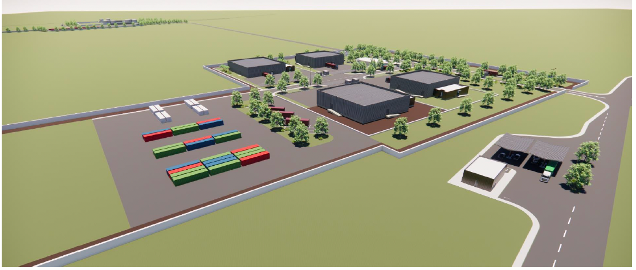
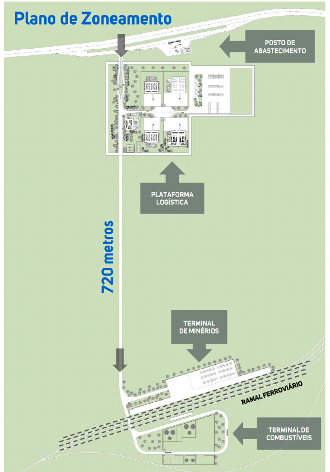
- Concession modalities: The government will launch a public tender for the concession (design, construction, operation and commercial management) of the Luau Logistics Platform, with a 30-year contractual period, after completing the initial studies and projects.
- Multimodality and logistics: The platform is expected to have connections to various modes (road, possibly rail, storage, distribution).
