

Mining and Metals Potential in the Corridor
The province of Benguela has relevant occurrences of industrial and metallic minerals, including deposits of manganese, iron and phosphates, with potential to support industries such as steel production, fertiliser manufacturing and construction materials. Although less intensive in mining compared to other provinces in the corridor, Benguela benefits from a decisive advantage: its direct proximity to the Port of Lobito, making it a natural centre for mineral processing, storage and export installations from the interior.
Huambo is an emerging central hub in the corridor's mining sector, hosting one of the country's most strategic projects: the Longonjo Rare Earth Project, developed by Ozango Minerais SA (Pensana PLC). The Longonjo deposit is one of Africa's most important rare earth sources, particularly NdPr (neodymium and praseodymium), critical minerals for electric vehicles, wind turbines and advanced technological applications. The province also has occurrences of iron, gold, quartz and industrial minerals with significant expansion potential. The rail link to the CFB strengthens Huambo as a mining hub oriented towards export and industrial processing.
Bié has a diversified geology, with occurrences of gold, alluvial diamonds, quartz, granite, limestone and iron potential, although still underexplored. The province has vast areas of active prospecting and significant potential for the development of medium-scale projects linked to formalised artisanal mining, as well as opportunities for expanding industrial exploitation.
Moxico and Eastern Moxico are the provinces with the greatest mineral weight in the Lobito Corridor. Integrated in the "Angolan Copperbelt", they have vast reserves of copper, cobalt, manganese and other critical metals fundamental to the global energy transition. Several concessions are active or in an advanced prospecting phase, positioning Moxico and Eastern Moxico as the epicentre of the corridor's future mining value chain. The proximity to the DRC and Zambia mining markets, combined with direct Atlantic access via the CFB, gives these provinces a central role in the corridor's international competitiveness.
1º
largest concentration of critical minerals
4%
of global NdPr (rare earth) supply

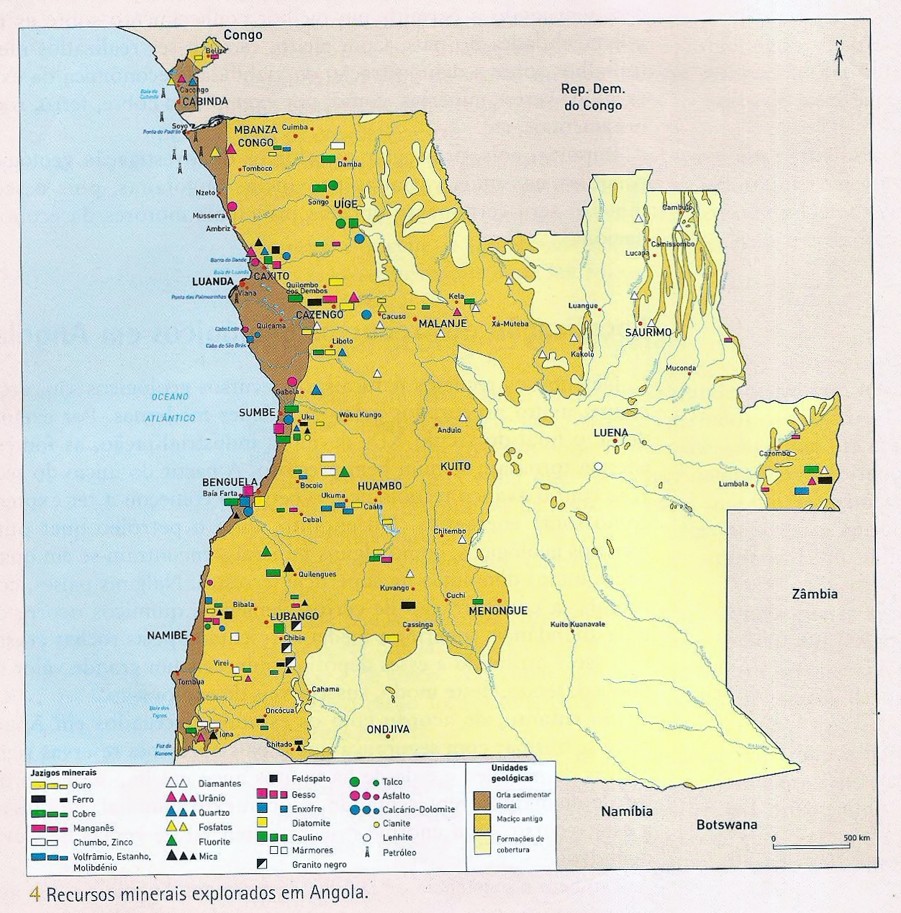
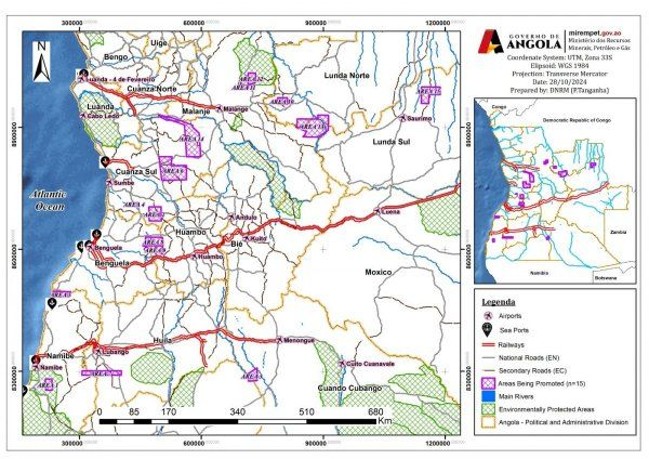
Main Mineral Resources of the Lobito Corridor
Why invest in Angola
Angola is decisively emerging as one of the most competitive destinations in Africa for mining investment, thanks to a unique combination of geological resources, strategic location, reformed regulatory environment and substantial improvements in logistics and infrastructure.
The country has one of the greatest geological potentials on the African continent, with important reserves of diamonds, iron, copper, gold, phosphates, rare earths and critical metals essential for energy and technological transition value chains. A significant part of the territory remains underexplored, creating opportunities for large-scale discoveries and high-return investments.
The South Atlantic location, with direct access to international maritime routes, facilitates the flow to European, American and Asian markets. The Lobito Corridor, driven by the international concession and growing rail capacity, has become one of the most efficient logistics corridors in Africa, directly linking the Zambia and DRC Copperbelt to the Port of Lobito — reducing time, costs and operational risks.
At the same time, Angola has been advancing with deep reforms in mining legislation, the concession system and licensing mechanisms, offering greater predictability, transparency and investor protection. These improvements, combined with growing political stability and incentives for foreign investment, reinforce the country's competitiveness.
With extensive resources, strategic logistics corridors and a modernised regulatory environment, Angola offers unique conditions for sustainable, integrated mining investments oriented towards rapidly growing global markets.
Did you know?
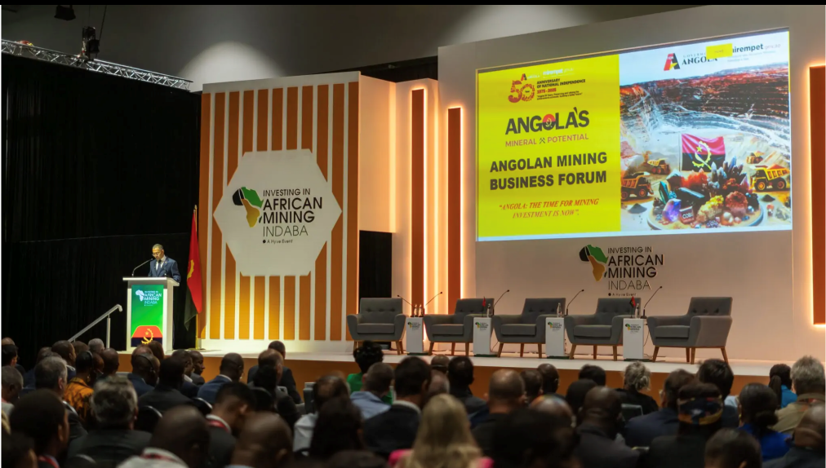
The Government of Angola promoted areas with geological and mining potential at the business forum held on 4 February 2025 in Cape Town, South Africa, at CTICC Hall 9.
The event, coordinated by the Minister of Mineral Resources, Petroleum and Gas, Diamantino Azevedo, took place on the sidelines of the 31st edition of the International Mining Conference and Exhibition "Mining Indaba 2025", which took place from 3 to 6 February 2025.